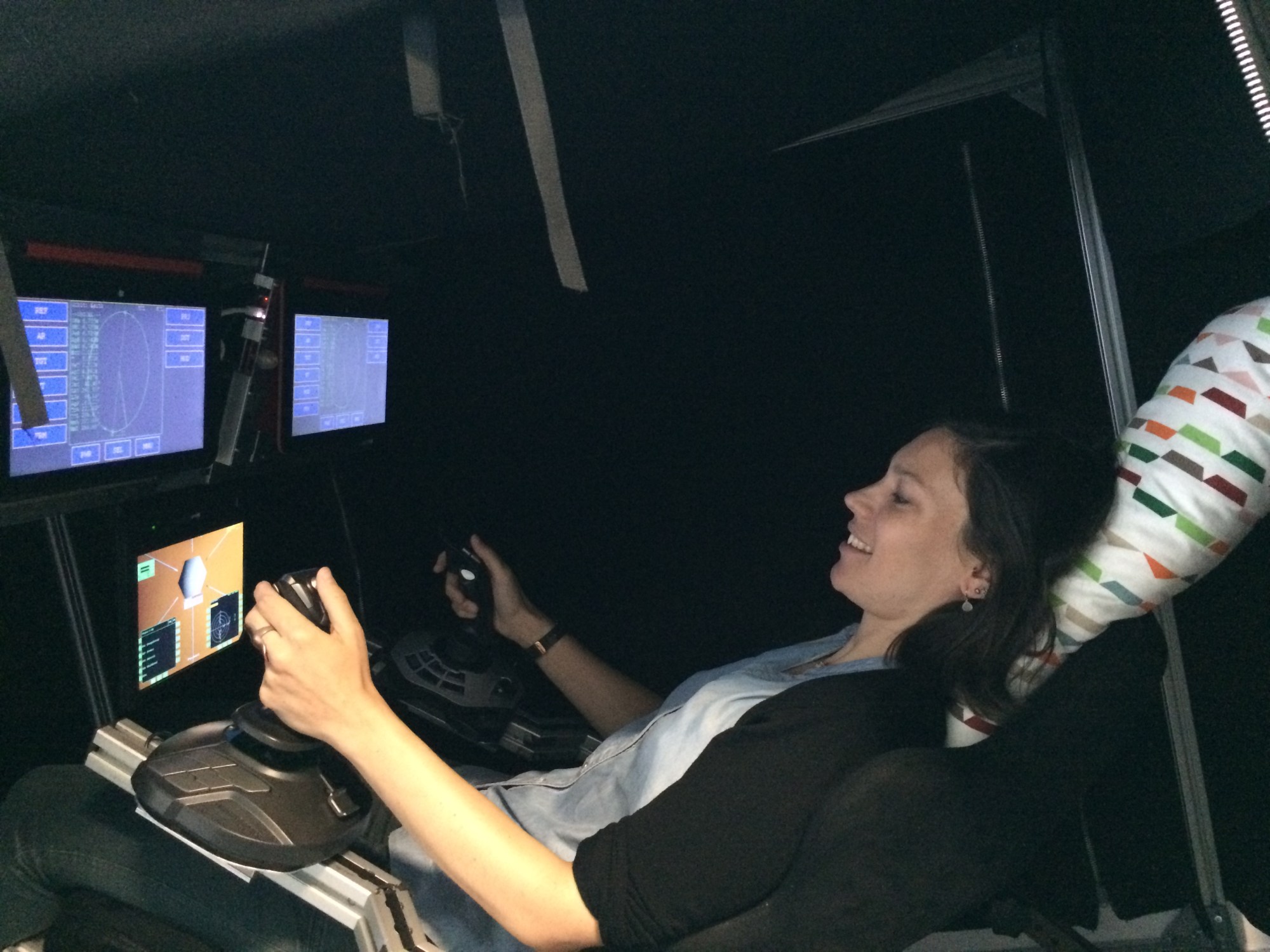
End of August I then flew out to Stuttgart for training on the Simskill program at the Institute of Space Systems at the University of Stuttgart, home to the offices of the p.i. and German astronaut Ernst Messerchmid. Miquel Bosch Bruguera from the Institute provided the Soyuz theoretical and practical simulator training. Emilie Dessy from the Royal Military Academy of Belgium trained me on the Vienna test system, which evaluates psychomotor skills. In addition, Leonardo Surdo, Project Scientist at ESA’s Human Research Office, accompanied me throughout the week. I had the chance to work in what was an exceptional and incredibly inspiring environment, surrounded by dozens of models of satellites, rocket launchers and posters of various space missions as well as the research conducted at the Institute. The hallways are truly like a little museum dedicated to space. I also had the chance to visit the lab where a satellite due to launch in a few months was being tested.
The goal of Simskill is to test for any signs of degradation of high-performance skills in an environment such as Concordia, which can be poorly stimulating and become monotonous after months of routine. Again, this is similar to spending months on a spaceship whilst travelling through space. Would astronauts arriving to Mars risk losing their ability to perform such complex manoeuvres as landing a capsule, and could regular training help lessen these effects? Tackling 2 joysticks simultaneously to manoeuvre in all possible directions (6 degrees of freedom : throttle or up and down, front and back, left and right, roll, yaw and pitch) whilst learning about translational and rotational offset and velocities was not spontaneous at first, but it was definitely a lot of fun, and I earned my flying wings !!!
 75 Degrees South