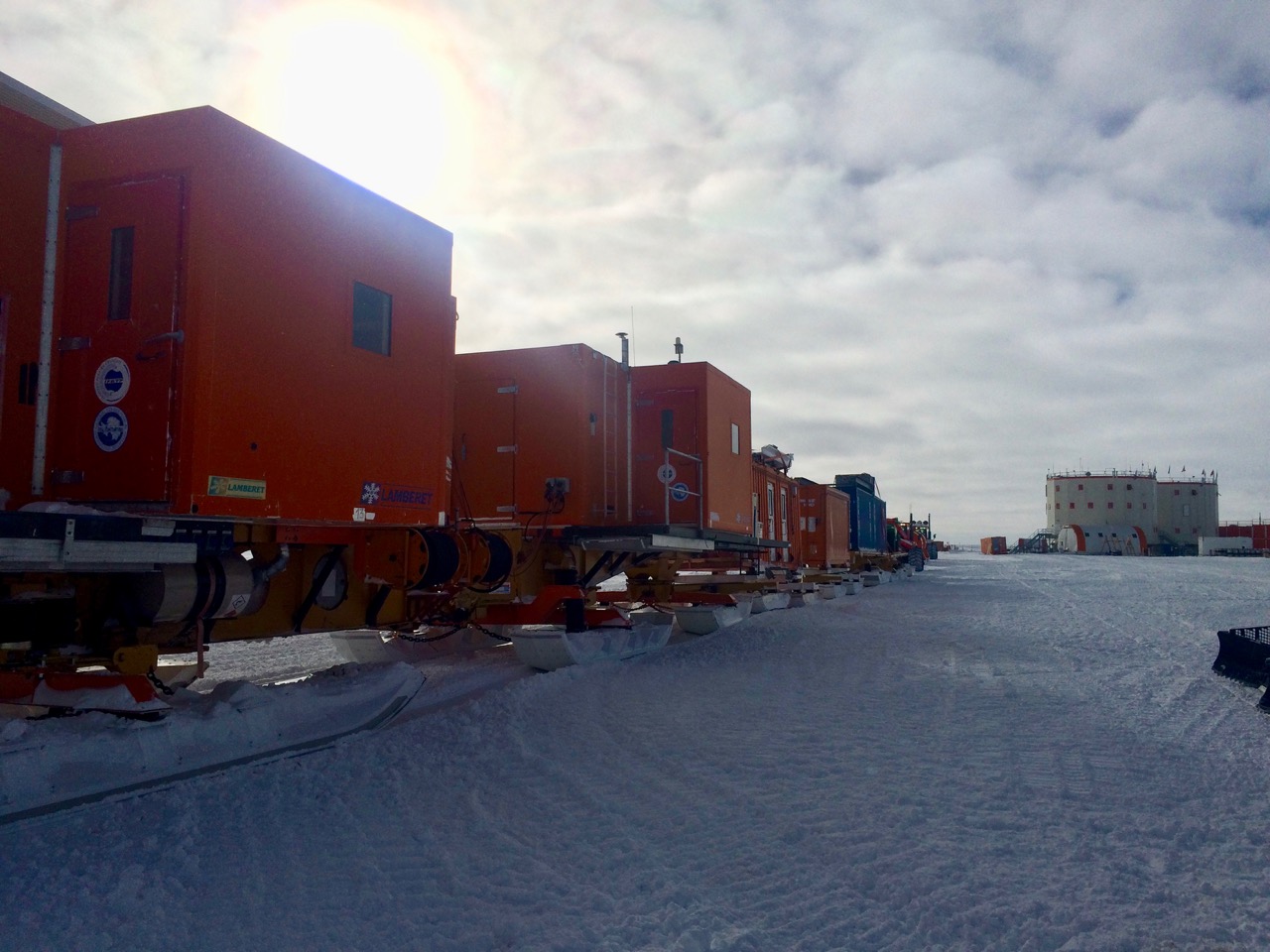
Soon enough I discover that the arrival of each raid is a significant event for the whole station, and is eagerly awaited. Not least because it brings much-needed fuel and provisions, as well as equipment and supplies for the day to day running of the station and construction of the new buildings. A raid team is most often composed of 6 to 8 drivers, one of whom is a doctor and is responsible for cooking the meals for everyone. The majority of the other drivers are mechanics, which ensures the team is independent for the maintenance of the vehicles and any urgent repairs. The vehicles are submitted to very rough conditions, cautiously crawling on the snow track in extreme cold temperatures, whilst pulling many tons of cargo on sledges. The leading vehicle is equipped with powerful projectors worthy of a football field, whilst the last vehicle tows a snow groomer to level the track and ensure it is safe for the return voyage.
The drivers cover about 1000 kilometers in 10 days, driving for hours on a monotonous white track, with not a tree or sign post anywhere on the horizon, and the sky and ice fields often blurring into one. The track links Concordia Station on Dome C and Cap Prud’homme, the French storage and refueling station on the Antarctica coast, 5 km away from Dumont D’Urville, itself located on the Petrel island. There are generally 3 raids during the summer campaign. The first raid is often the most arduous as the track has been covered by months and months of Antarctica winds and storms; GPS location ensures the drivers are heading in the right direction. The first 100 kilometers are the most dangerous, as the trucks must make their way through a field of crevasses. It is then a sluggish and gradual ascent from approximately sea level to the 3233 meters of the Dome C plateau. On their way, the drivers must also level the taxiway located at “midpoint”, the refueling stop for the Twin otter planes which link MZS, DDU and Concordia.
The first raid is scheduled for early December 2016. Early one morning, the drivers communicate by radio their expected hour of arrival. A few hours ahead, armed with binoculars, a few of us position ourselves at the window of the radio room, the highest vintage point from which we can act as lookouts whilst staying warm. Eureka! We first spot the smoke of the chimneys before we can discern the trucks themselves. Following the tradition, as soon as they are close enough, roughly at the level of the wooden panel radar (courtesy of a previous humorist winter-over crew), a few of us go out in skidoos to greet the team. The trucks are impressive as they slowly and majestically turn in the open space between the station and the summer camp, parking themselves in single file. It all looks like a perfectly orchestrated ballet!
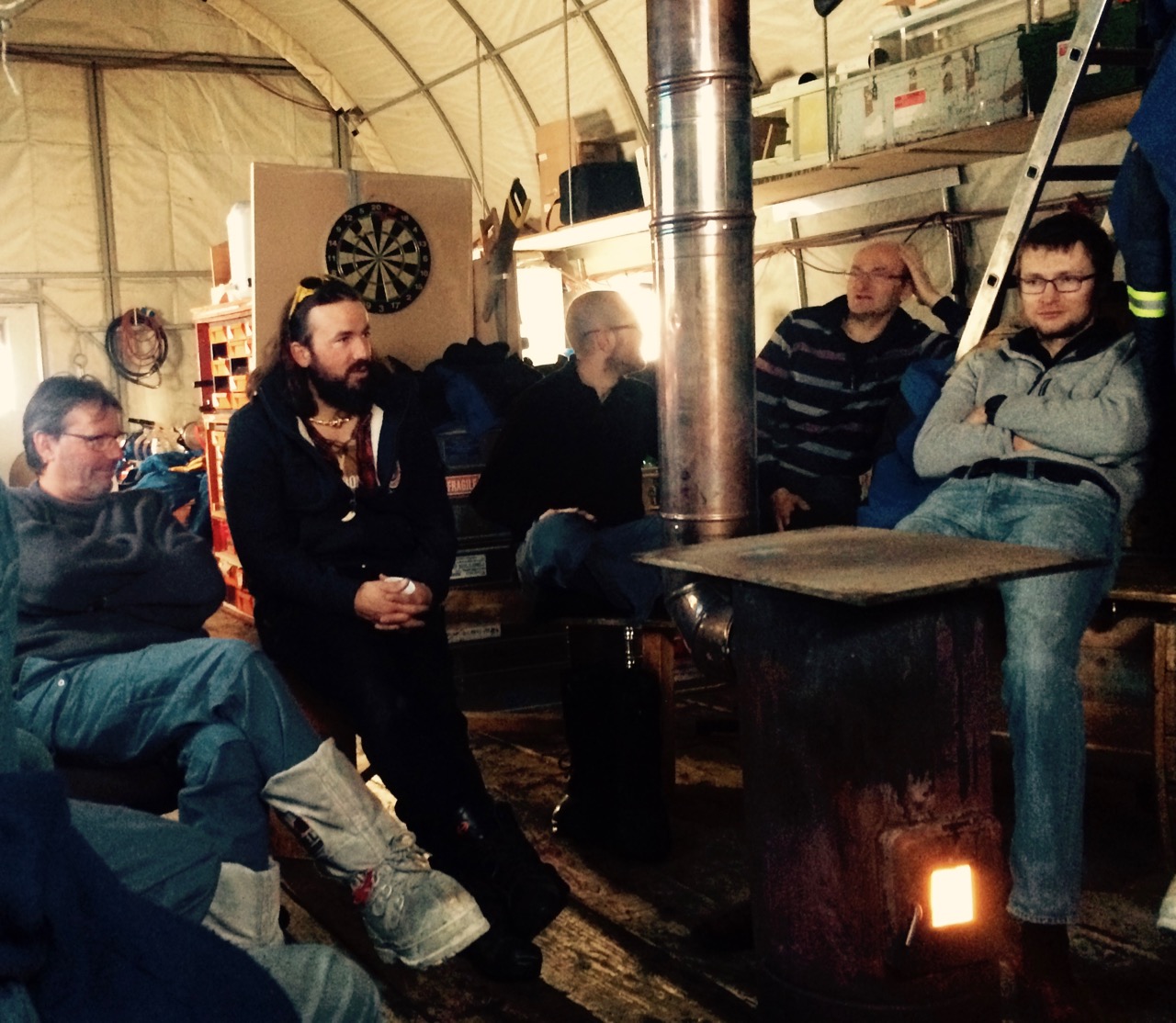
I am lucky enough to have met the doctor from the first raid, Julien, during my training in Chamonix. He shows me around all the caravans and gives me a little insight into the tight schedule all the drivers must follow during their Antarctica traverse. Although it is a fabulous voyage, each day is essentially filled with long hours of driving and not many distractions, apart from music and podcasts. It is sometimes hard to stay focused on the endless track, (especially when wind and drift make it disappear!), as each driver is isolated in their respective cabins. Evening meals are the most convivial, with everyone reuniting and huddling on the narrow benches in the living quarter’s caravan. Just as the pilots of the various planes stay on one single time zone throughout all their flights, the drivers stay on the DDU time zone, 2 hours ahead of us. They are a welcome addition to meals on the station, as well as evenings at the Epica tent, livening up the discussions with their accounts of years past. Some of the drivers have been doing the raid for a long time, and are an inexhaustible source of entertainment! They also share a welcome apero in one of their caravans; the confined space, partly due to us being double in size with our suits and big boots, makes for a cheerful atmosphere! The drivers only stay 2 or 3 days on the station; enough time to unload the containers, reload all the waste which must go back to the coast, resupply themselves in food and off they go, having barely rested… For their departure, we escort them once again with the skidoos. Once they have disappeared over the horizon, the grounds suddenly seem a little emptier and quieter!
Beautiful Pléiades satellite pictures of the raid: http://apps.intelligence-airbusds.com/MapJournal/?appid=8e0e4b6c236f47bd9a9d97eb1c5a19bd
 75 Degrees South